We use cookies to measure traffic and to show relevant advertising. Nothing is stored or sent until you choose, and you can change your choice at any time.
An activated alumina compressed air dryer only performs if the alumina grade matches the dew point you are trying to hold. For most plant and instrument air, a desiccant dryer charged with activated alumina holds a pressure dew point around −40 °C — ISO 8573-1:2010 water class 2 — and can reach −70 °C (class 1) where the duty demands it. The bead grade is then chosen for pressure drop, and the charge is normally replaced every three to five years in a heatless dryer. This page gives the grades, the numbers behind them, and what actually shortens bed life.
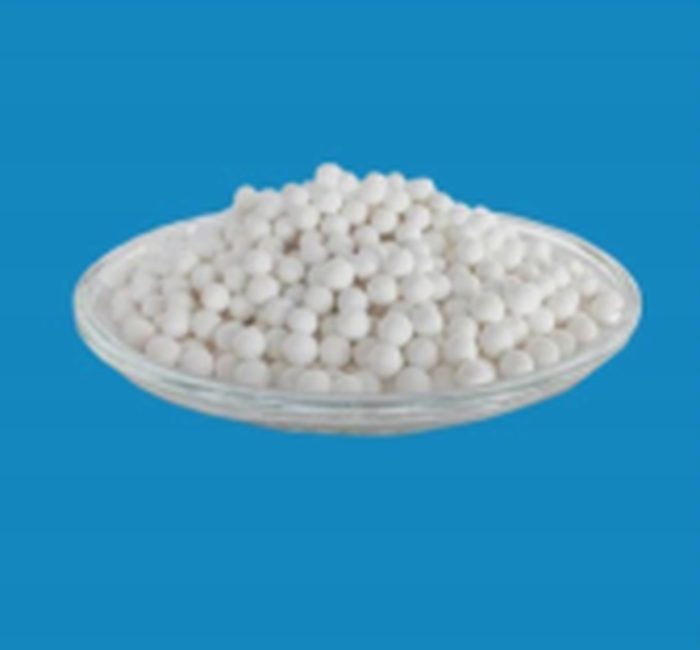
An air compressor takes in atmospheric air and squeezes it, and the water vapour it contains is compressed with it. As the air leaves the compressor it is hot and fully saturated: cool it — in an aftercooler, a receiver or the pipework — and that vapour condenses into liquid water. Left in the line, it rusts steel pipework, washes lubrication out of pneumatic tools, and freezes in instrument air lines in cold weather. A desiccant dryer removes the water vapour itself, which is why it reaches far lower dew points than a refrigerant dryer can.
The useful benchmark is the pressure dew point (PDP), the temperature at which water would start to condense at the working pressure. ISO 8573-1:2010 sets water purity classes by PDP, and they are the language a compressed-air buyer should quote in:
| ISO 8573-1 water class | Pressure dew point | Typical dryer that reaches it |
|---|---|---|
| Class 4 | +3 °C | Refrigerated dryer |
| Class 3 | −20 °C | Desiccant dryer (light duty) |
| Class 2 | −40 °C | Desiccant dryer — activated alumina or molecular sieve |
| Class 1 | −70 °C | Desiccant dryer with molecular sieve, or a deep-designed alumina bed |
Classes 5 and 6, at +7 °C and +10 °C, sit above the refrigerated range and are not what a desiccant bed is bought for. The practical point is that a refrigerated dryer stops near +3 °C, so anything that needs a PDP below freezing — outdoor instrument air, breathing air, powder conveying — needs a desiccant dryer, and activated alumina is one of the two standard charges for it.
Activated alumina for air drying is sold by bead diameter and by measured performance, not by a single mystery grade. The bead size sets the trade-off between mass transfer and pressure drop:
| Bead size (typical) | Effect in the bed | Where it fits |
|---|---|---|
| 1.5–3 mm | Fastest adsorption kinetics, highest pressure drop | Small vessels, low flow rates, short beds |
| 3–5 mm | Balanced kinetics and pressure drop | General compressed-air and gas drying |
| 4–6 mm | Lower pressure drop, slower mass transfer | Large-diameter vessels, high flow rates |
The larger the bead, the more freely air passes but the longer it takes to reach equilibrium; the smaller the bead, the faster the uptake but the higher the pressure drop the compressor has to overcome. That is why two vessels on the same duty can carry genuinely different grades, and why "activated alumina" alone is not a specification. Where a very low dew point is the requirement rather than bulk drying, the bed is often a molecular sieve instead; the trade-offs are set out in our alumina desiccant vs silica gel comparison and our activated alumina desiccant grades guide.
These are typical figures for the grade, not a guarantee for a batch. A capacity quoted without the humidity it was measured at means little — the same point we make in our desiccant TDS reading guide. Ask for the certificate of analysis for the actual delivery.
Activated alumina is not consumed in service — it is a physical adsorbent, so it is restored by removing the water, and the bed keeps working until the material itself degrades. In practice the useful life is usually quoted as about three to five years in a heatless (pressure-swing) dryer, and around two to three years in a heat-regenerated dryer, with some makers recommending replacement every two years or roughly 4,000 operating hours.
What takes the life out of a bed is rarely the alumina itself:
Two regeneration regimes dominate compressed air. A heatless dryer swings the beds quickly and regenerates the offline bed with a slip stream of already-dried product air — no heater, but it costs compressed air. A heat-regenerated dryer passes heated gas through the spent bed, usually from an external heater or from the compressor's own heat of compression. Heatless desiccant dryers are typically designed to work over roughly 50–150 psi (about 3.4–10.3 bar), which is the usual plant-air band. Whichever regime is used, the regeneration target is the same: drive the water off without overheating the material or shocking it thermally.
Tell us the dew point class, the flow and the dryer type and we will recommend the grade and quote the charge. The material itself is on the activated alumina page, and the wider context — including where alumina loses to silica gel and molecular sieve — is in our activated alumina guide.
Written by the VEN Desiccant export team from the equipment standards our industrial buyers specify and the datasheets our suppliers issue. Drafting was AI-assisted; the standard numbers and the grade ranges were checked and edited by our team before publication. We publish it so a buyer can specify an activated alumina bed by dew point and grade instead of by brand name, and plan the bed change instead of discovering it during a shutdown. Treat the certificate of analysis for your actual delivery as the controlling document.
Last checked: 11 October 2026.
Send the dew point class, flow rate and dryer type — we will recommend the bead grade and quote the charge.