We use cookies to measure traffic and to show relevant advertising. Nothing is stored or sent until you choose, and you can change your choice at any time.
Before you accept a desiccant quotation, check that it names the grade, the unit weight and sachet material, the quantity, the price basis and currency, the Incoterms, the quote validity, the payment terms, the lead time, the packing and carton data, and the documents. A price with no grade is not a quotation — it is a number that lets a supplier ship you a cheaper product than you thought you bought. This checklist is what we would want a buyer to hold us to, and it is the fastest way to compare two suppliers on equal terms.
The single most important line. "Silica gel" is not a grade: the quotation has to state the pore type (Type A narrow, Type B or Type C coarse), the form (bead or granular), the particle size, and the performance figure the product is sold against. If the quote gives a capacity, it must state the relative humidity it was measured at — a capacity quoted without an RH means nothing. The same discipline runs through our desiccant TDS reading guide.
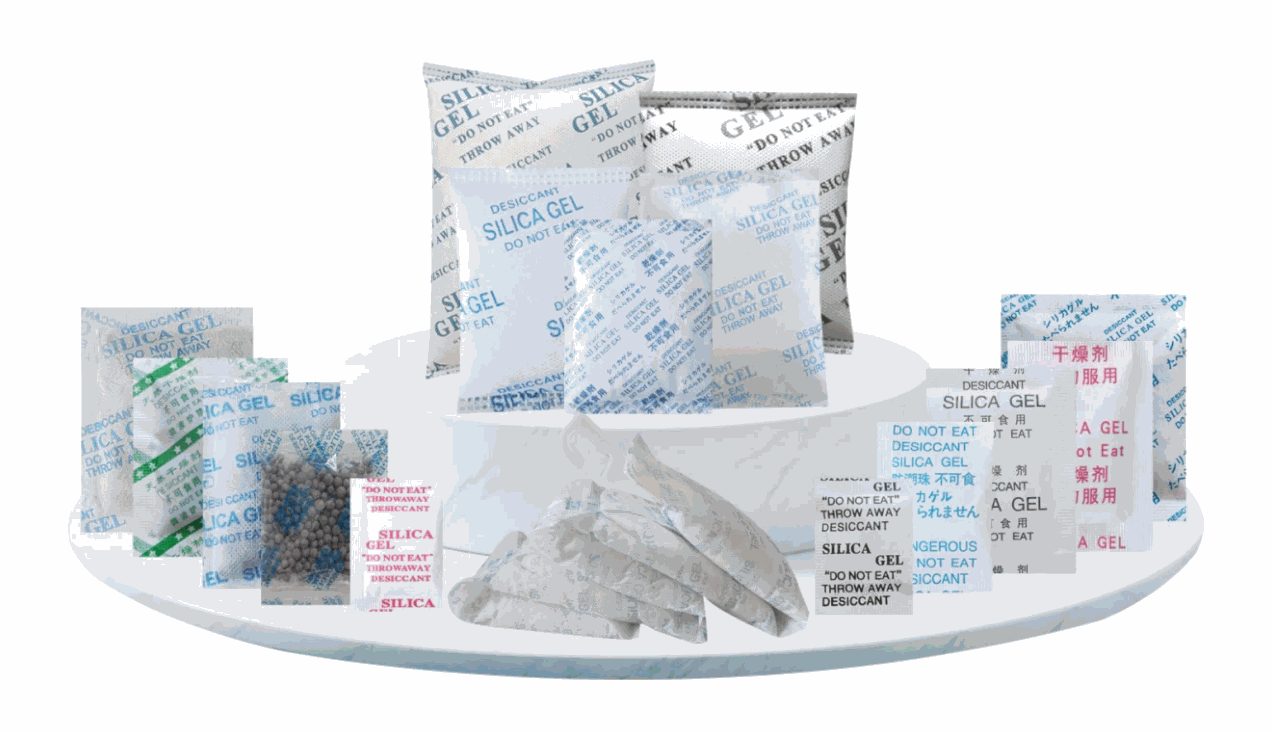
The price of a sachet is set as much by its weight and film as by the gel. A quotation should state the sachet weight — our industrial range runs from 0.5 g to 1,000 g — and the sachet material: composite paper, tea paper, non-woven, OPP film or DuPont paper, each with its own cost and its own food-contact status. A quote that gives a weight but no material, or a material but no weight, is half a quotation.
Write down what the price is per: per sachet, per kilogram, or per carton — and in which currency, since that decides your real cost once it is converted and paid. Check the quantity the price applies to, and whether the supplier quotes tiered breaks (for example 1, 5 or 20 tonnes) or a single figure. Compare on the same basis or the comparison is meaningless. The cheapest figure per kilogram is often not the cheapest per protected pack, because a lower-capacity product needs more of it to do the same job.
The quotation should name the trade term under the ICC's Incoterms 2020 — one of the 11 rules, of which FOB and CIF are the most common in desiccant trade. FOB means you arrange and pay the main freight and insurance; CIF means the seller does, to the named port. The term decides who carries the freight, the insurance and the risk at each point, so a price with no Incoterm is not comparable to one with it.
For a container-load order, the packing data is part of the cost: sachets per carton, cartons per pallet, and the carton dimensions and gross weight, from which you can build the CBM and check how the load fills a 20ft (about 33 m³) or 40ft (about 67 m³) container. The HS code should be named too — silica gel desiccant is classified under 2811.22 (silicon dioxide) — so your customs broker and your landed-cost calculation start from the right heading.
List the documents you need before the goods ship, and check the quote includes them rather than "on request": a technical data sheet, a safety data sheet, a batch certificate of analysis, and any compliance statement your market requires. Where the sachet touches food or a drug, that includes the food-contact declaration, and where the goods enter the EU packing chain, the heavy-metal documentation under PPWR Article 5(4) and its 100 mg/kg combined limit. Quality-system certificates are commonly to ISO 9001 for quality, with ISO 14001 and ISO 45001 for environment and safety.
| Field | What a usable quotation shows | Red flag |
|---|---|---|
| Grade and spec | Pore type, form, particle size and capacity at a stated RH | "Silica gel" with a capacity and no RH |
| Unit weight and material | A sachet weight and a named film | A weight with no material |
| Price and currency | Per-unit basis, currency, and the quantity it applies to | A lump figure with no basis |
| Incoterms | A named Incoterms 2020 rule | "Ex-works-ish" or nothing at all |
| Validity and payment | A validity date and a payment split | "Prices subject to change" with no terms |
| Lead time | Days from confirmation, stock or production | A lead time quoted only verbally |
| Packing data | Sachets per carton, cartons per pallet, gross weight | No packing information for a container order |
| Documents | TDS, SDS, COA and the compliance statements named | "Documents on request" with none listed |
Two quotations, one 15% cheaper per kilogram, can reverse once you look past the price. A lower-capacity product needs more grams to hold the same moisture, a thinner sachet film tears in transit, an undocumented film stalls a food-contact review, and a vague lead time turns into a delay that costs more than the saving. Compare on the cost of protecting the actual shipment — for a container load, that is the number of units and their capacity, not the price per kilogram alone — and require the documents up front. How to bind all of this into the order itself is the subject of our guide to writing a desiccant specification for a purchase contract.
Our own industrial desiccant and Type A silica gel lines are quoted from one tonne, with grades, weights and packaging made to specification, and OEM/ODM available.
Written by the VEN Desiccant export team from the quotations we issue and the ones our buyers receive from other desks. Drafting was AI-assisted; the trade terms and the classification were checked and edited by our team before publication. We publish it so a buyer can compare desiccant suppliers on equal terms and spot the gaps before signing. Treat the signed purchase contract as the controlling document, not the quotation.
Last checked: 11 October 2026.
Send your grade, weight, sachet material, quantity and destination — we will quote against every field above.