We use cookies to measure traffic and to show relevant advertising. Nothing is stored or sent until you choose, and you can change your choice at any time.
The grades that qualify as food grade silica gel are the plain, non-indicating and the cobalt-free indicating types, supplied in a sachet material that is itself cleared for food contact. What disqualifies a product is almost never the silica gel — it is the cobalt chloride in blue indicating gel, or an undocumented sachet film. And "food grade" is not a property you can assert; it is a chain of documents that each name the material, the food type and the conditions of use. This page covers the grade ladder and the five pieces of paper a buyer should hold.
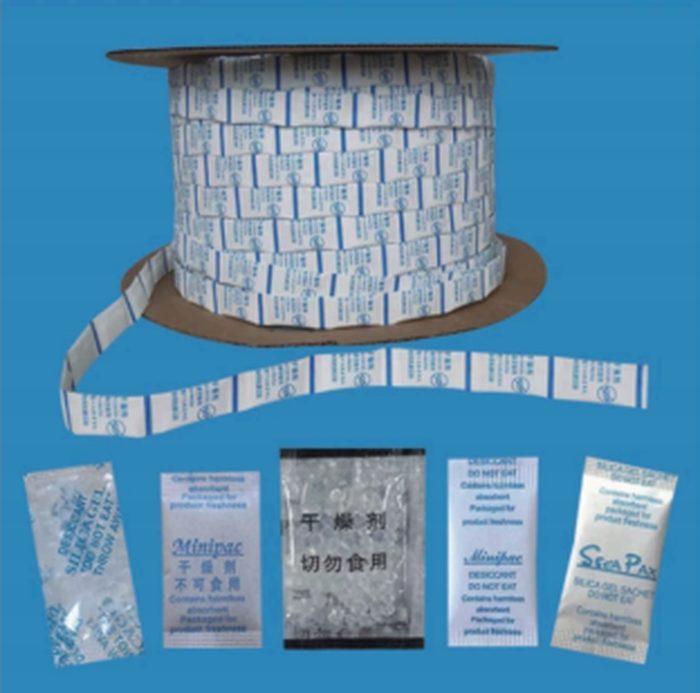
Start from what the gel is. Our Type A narrow pore silica gel is synthetic amorphous silicon dioxide — chemically inert, odourless, non-toxic and non-reactive with the packed product. Amorphous silica of this kind is not crystalline (free) silica, which is the form that carries a respirable-dust hazard. That inertness is why a plain silica gel sachet can sit beside food; the question is then which variant and which sachet.
| Grade | Food-contact status | Why |
|---|---|---|
| Plain, non-indicating silica gel (Type A narrow pore) | Qualifies | Inert amorphous SiO₂; no indicator dye; the default for food and pharmaceutical packs |
| Cobalt-free colour-indicating silica gel (orange / green) | Qualifies, where the indicator is cleared | Shows saturation without cobalt; check the specific indicator chemistry against your market |
| Blue indicating silica gel (cobalt chloride) | Does not qualify for food contact | The cobalt chloride indicator is the disqualifying component, not the silica — see cobalt-free indicating silica gel |
| Molecular sieve / clay / other desiccants | Varies by type and use | Food and pharma use each has its own basis; specify the duty, not just the material |
The grade also has a physical specification: bead or granular form, a stated particle-size band, and a sachet weight that runs from about 0.5 g to 1,000 g for our industrial food range. A food-grade product is declared against that physical description, so the sachet weight and the gel grade have to match the declaration you are handed.
Two more signals matter on the gel itself. A food-grade product should arrive dry — a low loss-on-drying figure — and it should be supplied with a pH and a heavy-metal statement appropriate to the market. Where colour-indicating gel is used, confirm the indicator is not cobalt-based; where the pack enters the EU, the sachet sits inside packaging that may fall under the heavy-metal limit of Regulation (EU) 2025/40 (PPWR), covered in our PPWR heavy metals page.
This is the mix-up that causes the most confusion. Silicon dioxide is authorised as a direct food additive — as an anticaking agent in powdered foods, for example — under 21 CFR 172.480 in the United States, which permits it at not more than 2% by weight of the food, and as E 551 in the European Union. That authorisation is for silica you eat, in a specific role.
A desiccant sachet is a different article. It is not an ingredient; it is a food contact material that sits in the pack, and it is governed by the food-contact rules rather than the additive rules. In the US, the FDA cites silica gel as a food contact substance to a narrow, use-specific section, 21 CFR 175.390. So a supplier who answers "food grade, it's E 551" has quoted the additive authorisation for an article that is not an additive. The full regulatory map — EU 1935/2004 and 10/2011, FDA 21 CFR, China's GB 4806 series and USP <670> — is set out on our food and pharmaceutical packaging compliance page. What follows is only what the paperwork has to show.
Five documents carry the claim, and each has to name specifics. A document that says only "food grade" proves nothing.
| Document | What it must name |
|---|---|
| Declaration of compliance / food contact statement | The material, the food types it may contact, and the conditions of use (dry, fatty, aqueous, frozen, retort) — not a blanket "food grade" |
| Sachet-material declaration | The paper, non-woven, OPP or composite film that encloses the gel, plus its printed ink and adhesive — this is the part that actually touches food |
| Batch certificate of analysis (COA) | The gel grade, moisture content (loss on drying), pH, and the heavy-metal figures your market requires, for the actual batch shipped |
| Safety data sheet (SDS) | Handling, storage and disposal; the gel grade the sheet refers to |
| Cobalt / indicator statement | Confirmation of whether the indicator is cobalt-based, and if not, what it is |
Tell us the market, the food and the sachet structure and we will say which of the grades above applies and which documents we can issue. The product line is on our medicinal and food desiccant page, and where the gel indicates, the cobalt-free option is on the cobalt-free colour-changing silica gel page.
Written by the VEN Desiccant export team from the food-contact documents our buyers request and the regulations named above. Drafting was AI-assisted; the regulation numbers and the document requirements were checked and edited by our team before publication. We publish it so a buyer knows which grade qualifies and which paper has to name what — and does not accept a "food grade" claim that no document supports. Always treat your buyer's written specification as the controlling requirement.
Last checked: 11 October 2026.
Tell us the market, the food and the sachet structure — we will name the grade and the documents we can issue.