We use cookies to measure traffic and to show relevant advertising. Nothing is stored or sent until you choose, and you can change your choice at any time.
Bulk 3A, 4A, 5A and 13X molecular sieve trades at roughly USD 1.15–1.25 per kg on the Chinese market in tonne quantities, which corresponds to about CNY 8,300–9,000 per tonne. Buying the same material by the kilogram at retail costs USD 2.4–3.5 per kg — roughly two to three times as much. Everything below explains that gap, and every figure on this page is a reference range rather than an offer: prices move with raw material and freight, so the number that counts is the one you get on the day you ask.
Two different markets exist for the same material, and they are quoted in different units.
Tonnes. The Chinese bulk market for zeolite molecular sieve was reported at CNY 8,350 per tonne on 15 October 2026 by ChemicalBook, with SunSirs quoting a CNY 8,300–9,000 band for the same month. At CNY 7.2 to the dollar that is USD 1.15–1.25 per kg, ex-works.
Kilograms. Retail listings on 1688, the Chinese domestic wholesale platform, were quoting CNY 17–25 per kg in October 2026, with a minimum order of 1 kg and no volume tiers. That is USD 2.4–3.5 per kg.
Within the retail band, the grade gradient is clean — same seller, same pack size, same month:
| Grade | Pore size | Retail, CNY/kg | Retail, USD/kg | vs 4A |
|---|---|---|---|---|
| 4A | 0.4 nm | 17 | 2.4 | baseline |
| 3A | 0.3 nm | 20 | 2.8 | +18% |
| 5A | 0.5 nm | 22 | 3.1 | +29% |
| 13X | 1.0 nm | 24 | 3.3 | +41% |
Why 13X carries the highest premium. Its pore opening is an order of magnitude wider than the Type A grades, so it can take up carbon dioxide and larger hydrocarbons as well as water. That wider window demands tighter control during synthesis and calcination, and the yield is lower.
Why 3A costs more than 4A. 3A is 4A that has been potassium-exchanged. The extra exchange, washing and re-calcination add cost. What the buyer pays for is selectivity: a 0.3 nm opening admits water at 0.28 nm and holds back almost everything larger, which is exactly what ethanol dehydration and refrigerant drying need. Our comparison of molecular sieve, silica gel and activated alumina covers when that selectivity is worth paying for.
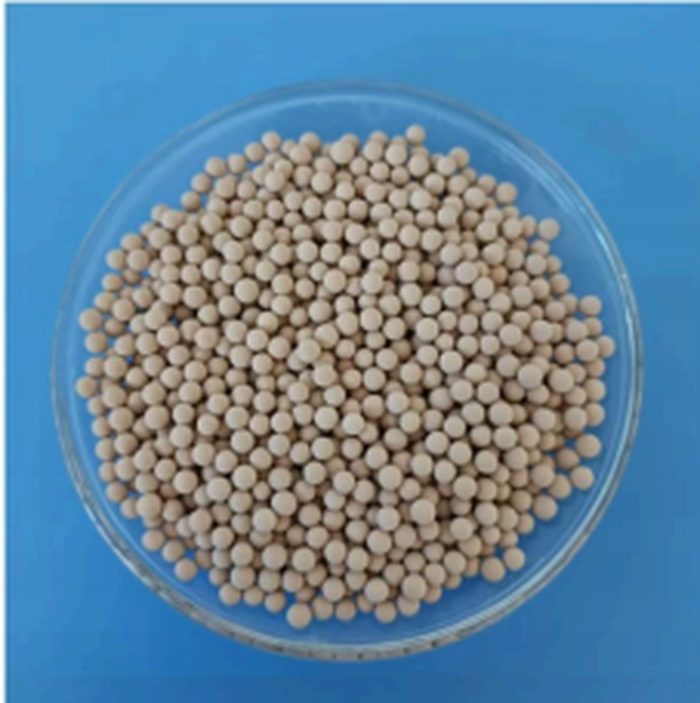
Look at what is quoted publicly for the same family of product on the same day, and the spread is far wider than the grade premium:
| Where it is bought | Listed price | Per kg | Multiple of bulk |
|---|---|---|---|
| China, tonne quantity | CNY 8,350/t | USD 1.16 | 1× |
| China, 1 kg retail | CNY 17–25/kg | USD 2.4–3.5 | 2–3× |
| US laboratory supplier, 150 kg drum | USD 1,430 | USD 9.53 | 8× |
| US laboratory supplier, 1 kg | USD 108.95 | USD 108.95 | 94× |
| Analytical grade, 25 g | USD 62.40 | USD 2,496 | 2,150× |
These are not four prices for one product. They are four different products, and the differences are real:
The practical conclusion: a per-kg figure means nothing until you know the quantity, the particle band, the packaging and whether a COA is included. A quote that states none of those four is not a quote you can compare.
Molecular sieve prices are re-quoted rather than held, for two reasons that have nothing to do with sales tactics.
Raw material. The Type A grades are built from sodium silicate as the silica source and sodium aluminate as the alumina source; 3A additionally consumes a potassium salt for ion exchange. All of these track the wider commodity cycle for soda ash, caustic soda and bauxite. Calcination runs hot, so the electricity tariff feeds straight into cost.
Freight. This is a dense cargo charged by weight. Ocean rates and inland haulage are a meaningful share of landed cost, and when capacity tightens they can move sharply within weeks. It is the main reason an FOB figure and a CIF figure for the same lot can look unrelated.
Treat any published range — including the ones on this page — as a budget instrument. For a purchase decision, ask for a quote on the day.
| Parameter | Common options | Effect on price |
|---|---|---|
| Grade | 3A / 4A / 5A / 13X | Up to 41% across the range, from the table above |
| Form | Bead / pellet | Pellets are extruded, cut and re-dried, so they carry a premium over beads |
| Particle size | Bead 1.6–2.5 mm or 3–5 mm; pellet 1.6 or 3.2 mm | Narrower bands mean more screening and lower yield |
| Bulk density | 0.64–0.70 g/ml | Changes how many kg a given bed holds, not the unit price |
| Packaging | 25 kg woven bag, paper-plastic laminated bag, steel drum, bulk bag | Drums and bulk bags carry a premium; moisture barrier adds cost |
| Quantity | Sample, trial, LCL, full container | The single largest variable in the unit price |
Bead or pellet. Beads are formed by rolling, which gives a low pressure drop and suits pressure-swing duties. Pellets are extruded, which gives higher crush strength and suits deep beds. Choosing the cheaper form for the wrong duty is a false economy: the pressure drop you accept is paid for in compressor energy for the life of the bed.
Particle size. A 1.6–2.5 mm band is screened out of the same production run as 3–5 mm, and the yield is noticeably lower. That is why the finer band is not the cheaper one.
Two suppliers quote the same grade. One is USD 2.30 per kg at 19% static water adsorption; the other is USD 2.50 per kg at 21%. The cheaper one looks like the obvious choice, and it is the more expensive material:
| Quote | Price per kg | Water adsorption | Cost per kg of water held |
|---|---|---|---|
| A | USD 2.30 | 19% | USD 12.11 |
| B | USD 2.50 | 21% | USD 11.90 |
The calculation is simply price divided by adsorption capacity. On that basis B is about 2% cheaper per kilogram of water removed, even though it costs 8.7% more per kilogram of product. Multiply the difference across a multi-tonne fill and it is real money.
Then add the bed. Bulk density decides how much material a given tower holds. At 0.70 g/ml a 10 m³ bed takes 7,000 kg; at 0.64 g/ml the same bed takes 6,400 kg. The lighter material needs less capital outlay per fill — but it also holds less water per fill, which is why the metric above has to come first and the fill calculation second. The two numbers belong together, and neither one alone tells you which quote is better.
Where the bed is part of a running plant, widen the comparison further: purchase price × fill quantity, plus freight, plus loading labour, plus regeneration energy, plus the compressor power that pressure drop costs you, plus the replacement interval, plus the production lost during a changeout. A material that needs 10% more fill and regenerates more often can lose on total cost while winning on the invoice. Our guide to regeneration cycles on dehydration units covers how that operating cost accumulates.
Static water adsorption is the figure that most often hides inside a price difference, and it is the easiest to misread. Published values run about 19–20 wt% for 3A, 20–21 wt% for 4A and 21–22 wt% for 5A. Three rules turn those numbers into something you can use.
For the theoretical ceiling — around 25.5 wt% for the crystal — and the adsorption physics behind it, the literature is consistent; what varies commercially is how much of that ceiling survives manufacturing.
A 30% gap between two quotes for the same grade is usually not one supplier being expensive. It is two different products being compared. Align these six points first:
If the gap survives all six, it is a genuine price difference and worth negotiating. If it does not survive, you were never comparing the same thing.
A price is calculated, not guessed. These five details are enough to turn a range into a firm figure:
With all five we can quote against a specification instead of a range; with three of five we can still give a working band. For the fuller version of this list, including the technical detail worth attaching to a first enquiry, see our quotation checklist. The grades themselves, with bulk density and particle options, are on the molecular sieve product page.
How much does molecular sieve cost per kg?
In tonne quantities on the Chinese market, about USD 1.15–1.25 per kg. Bought by the kilogram at retail, USD 2.4–3.5 per kg. The difference is repacking, grading, scale and documentation — not a different material.
Why is 13X more expensive than 3A?
13X has a 1.0 nm pore opening against 0.3 nm for 3A, so it adsorbs a wider range of molecules including CO₂. The wider window is harder to control during synthesis, and the yield is lower. In the retail listings we compared, 13X carried a 41% premium over 4A and 3A carried 18%.
Is a cheaper quote actually cheaper?
Not necessarily. Divide the price by the static water adsorption figure to get cost per kilogram of water held. In the worked example above, a material costing 8.7% more per kg was 2% cheaper per kg of water removed.
Can I buy 1 kg to test?
Yes, and retail listings start at that quantity. Expect to pay two to three times the tonne rate, because repacking costs are spread across a single kilogram. Test the sample, then price the production quantity separately.
How long is a quote valid?
Short, and deliberately so. Raw material and freight both move. Treat a quote as valid for the period stated on it, and re-confirm before you place a repeat order.
What is the difference between FOB and CIF here?
FOB covers the goods to the port of loading; CIF adds ocean freight and insurance to your destination. On a dense cargo, that leg is a meaningful share of landed cost, which is why the destination port belongs in the first enquiry.
China bulk market: ChemicalBook molecular sieve price report, 15 October 2026 (CNY 8,350/t); SunSirs commodity report, October 2026 (CNY 8,300–9,000/t). China retail: 1688 marketplace listings for 3A, 4A, 5A and 13X, viewed October 2026 (CNY 17–25/kg, minimum 1 kg). Western laboratory supply catalogues, viewed October 2026: 1 kg from USD 108.95; 150 kg drum USD 1,430; analytical grade 25 g USD 62.40. Dollar conversions use CNY 7.2 = USD 1. All figures are reference ranges for budgeting, not offers, and move with raw material and freight.
Send the grade, the particle band, the quantity, the packaging and the destination port — we will come back with a firm figure rather than a range.