We use cookies to measure traffic and to show relevant advertising. Nothing is stored or sent until you choose, and you can change your choice at any time.
The difference between ocean and air freight is not the cargo — it is time and enclosure. An ocean shipment sits inside a sealed steel box for weeks, crossing climate zones, and that box generates condensation the whole way; an air shipment is out of the ground in a day or two, in a hold whose air is cold and dry. So container desiccant is usually essential on the water and usually the wrong purchase in the air. What changes is duration, the container itself, and where the water comes from. This page covers only those differences; the basics — which desiccant to use and how much per container — are in the guides linked below.
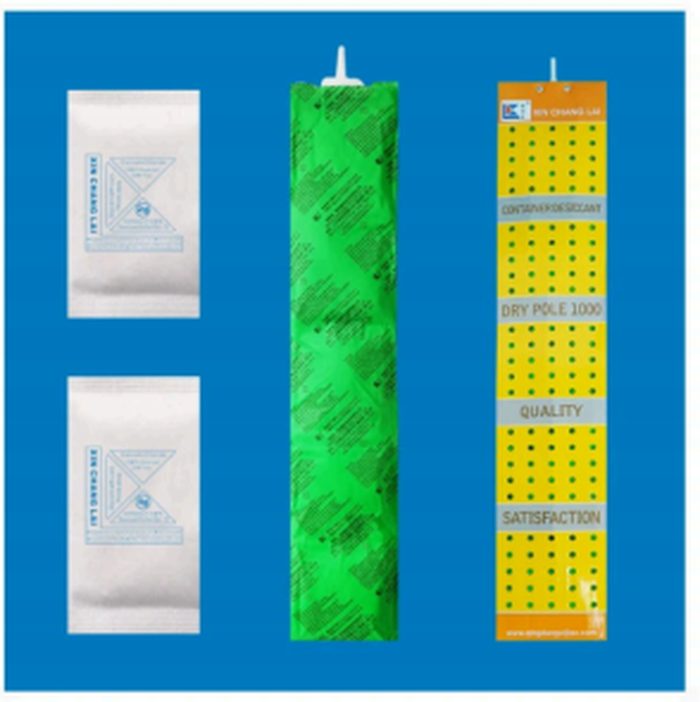
Condensation is not a single event; it is a cycle that repeats every time the sealed box warms and cools. On the water that cycle runs for weeks, so a container is loaded with moisture and given a very long time to sweat it out; in the air it runs for a day or two, and the box is gone before the cycle can repeat many times. That is the whole reason the two modes are specified differently.
| Factor | Ocean freight | Air freight |
|---|---|---|
| Typical transit time | About 30–35 days Asia–Europe; about 14–25 days trans-Pacific | About 1–3 days door to door |
| Enclosure | Sealed steel container, roughly 33 m³ (20ft) to 76 m³ (40ft high cube) | Open ULD or pallet in a pressurised hold |
| Air inside | Warm, humid, closed in with the cargo | Cold and relatively dry (low absolute humidity at altitude) |
| Condensation cycle | Repeats for weeks → "container rain" | Few cycles; mainly a fast ground-to-cruise shock |
| Is container desiccant needed? | Usually yes — sized to the voyage and the cargo | Usually no — use in-pack desiccant instead where warranted |
A shipping container is a thin, uninsulated steel shell. In direct sun its walls get hot enough to reach surface temperatures up to about 80 °C in the equatorial zone at midday, and then fall below 20 °C at night at sea — a swing that drives condensation onto the coldest surface, which is the roof. Interior air can climb to roughly 57 °C (135 °F) in extreme conditions. The water that condenses on the ceiling then drips onto the load: the phenomenon the trade calls container rain. Crucially, up to about 75% of the humidity inside a container can come from the cargo and its packaging — timber, paper, textiles and food all carry water in — so the box is not just fighting the outside air, it is fighting its own contents. That is why the ocean answer is a hung, high-capacity desiccant that works continuously for the whole voyage.
Air cargo travels in unit load devices (ULDs) or on pallets, not inside a sealed 40-foot steel box, and the hold is a very different environment. The air is pressurised to roughly 71–75 kPa — equivalent to an altitude of about 2,400 m (8,000 ft) — and because cold air holds very little moisture, the relative humidity in the hold is low. Outside the aircraft the air at cruise can be as cold as −55 °C, while measured hold temperatures in the main and lower decks have been reported in the range of about 10–32 °C depending on position.
The practical consequence cuts two ways. First, with no sealed box and a cold, dry hold, there is far less of the sustained condensation that a container desiccant is bought to defeat. Second, the airborne leg is short, so the number of condensation cycles is small. The real moisture risk in air freight is not the flight — it is the ground: tarmac exposure at a hot, humid origin while the pallet waits to be loaded, and the fast thermal shock of that hot, moist cargo meeting a cold hold. That risk is managed with in-pack desiccant and barrier packaging, not with hanging bags.
The expensive error is to treat the two modes as the same job. Putting hung calcium-chloride container desiccant into an air freight consignment buys nothing the in-pack sachet does not already cover, and it adds chargeable weight and handling. The reverse error — shipping a long ocean consignment with only in-pack sachets and no container-level protection — leaves the container rain unaddressed, and the cargo arrives mouldy or rusted. Match the protection to the mode: container-level on the water, pack-level in the air.
For the parts this page deliberately does not repeat — which material to choose, how many units a 20ft or 40ft load needs, and how container rain forms — read how many desiccant bags a container needs, preventing container rain on Gulf routes, and our comparison of the two container materials in calcium chloride container desiccant. The products are on the calcium chloride desiccant and montmorillonite desiccant pages.
Written by the VEN Desiccant export team from the shipping modes our buyers use and the container- and air-cargo references above. Drafting was AI-assisted; the figures and the transport logic were checked and edited by our team before publication. We publish it so a buyer choosing between ocean and air sees that the moisture specification changes with the mode — and does not buy the wrong desiccant for the wrong journey. Treat your own route data as the controlling input.
Last checked: 11 October 2026.
Send the route, the mode of transport and the cargo — we will recommend container-level or in-pack protection, and the quantity.