We use cookies to measure traffic and to show relevant advertising. Nothing is stored or sent until you choose, and you can change your choice at any time.
There are three ways to buy container desiccant — direct from a factory, through a regional distributor, or from an online marketplace — and they are not three prices for the same thing. They are three different allocations of risk. A factory quote is cheap per bag but leaves you owning the freight, the customs entry and the lead time. A distributor quote is expensive per bag because someone else already absorbed those. A marketplace listing is the most expensive of all and the only one where nobody will tell you which standard the dosage figure follows.
This guide breaks the purchase decision into the six things that actually change the number on the invoice: route, cost layers, MOQ, quantity per container, documents, and Incoterms. Every figure below comes with the condition it was measured under, because an absorption number without a temperature and a relative humidity is not data.
The three routes differ in who holds the inventory risk, who handles export formalities, and how much of the price is product versus service.
Buying factory-direct means you place one purchase order against one production batch. You get the lowest unit price, a batch-specific certificate of analysis, and the ability to specify bag size, hook type and fabric weight. You also get the export paperwork, the booking, and the payment risk. This route suits buyers who ship at least a few pallets at a time and who already have a freight forwarder.
Buying from a distributor means someone in your region already imported the goods and holds stock. You pay for that working capital in the unit price. In exchange you get local invoicing in your own currency, next-day or same-week delivery, no customs entry, and no minimum that requires you to forecast a year ahead. This route suits buyers who need fifty bags this month and cannot wait six weeks.
Buying from a marketplace means you buy from whoever ranks highest that week. The listing is optimised for conversion, not for disclosure. You will usually get a bag count per container, rarely a standard reference, and almost never a statement of what relative humidity the absorption figure was measured at.
| Route | Unit price | Who clears customs | Typical order size | What you are really buying |
|---|---|---|---|---|
| Factory direct | Lowest | You (or your forwarder) | Pallets to full containers | Control over specification and batch traceability |
| Regional distributor | Middle to high | Already done for you | Boxes to pallets | Local stock, local currency, short lead time |
| Marketplace listing | Highest | You | Single boxes | Convenience, and very little information |
Those are the three routes. Two further seller types turn up in quotations without being routes of their own, and both are worth naming because buyers walk into them by accident. A converter or repacker buys desiccant in bulk and repacks it into printed bags: a legitimate supplier, often priced between factory and distributor, but it cannot issue a batch certificate that traces back to the absorbent material. A trading company posing as a factory quotes at factory price with no production behind it, which is why the qualification questions in the companion guide matter even when the price looks right. If traceability matters for your customs file or your quality system, that distinction has to be settled before price.
A distributor's unit price is not a marked-up factory price. It is a bundle: the goods, plus the cost of holding them close to you, plus the cost of being able to sell you twenty bags.
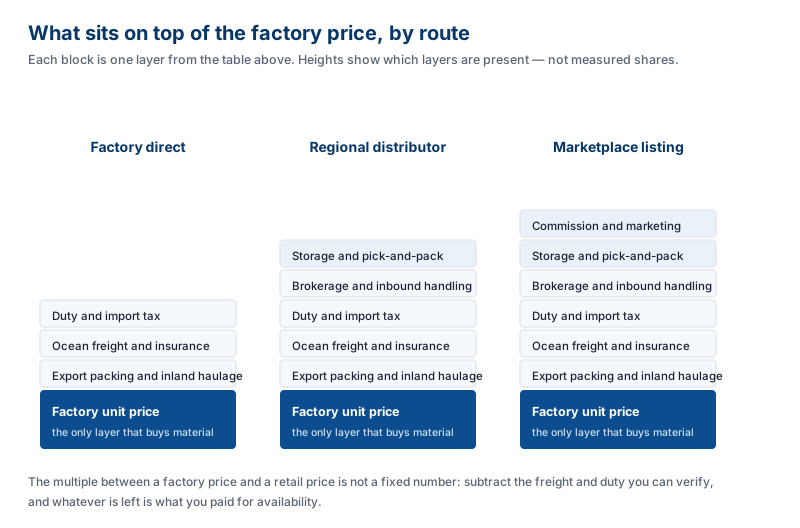
The layers are always the same, and they are always in the same order. Factory unit price. Export packing and palletisation. Inland haulage from plant to port. Ocean freight and marine insurance. Import duty and value-added tax, which is recoverable in some jurisdictions and not in others. Customs brokerage. Inbound handling into a warehouse. Storage, which is charged whether or not the goods move. Pick-and-pack, which is charged per order and is the single largest reason small orders are expensive. Platform commission, if the sale came through a marketplace. Marketing spend, because someone has to pay for the listing to be seen.
| Layer | Added by | Can you remove it? | What it costs you in practice |
|---|---|---|---|
| Factory unit price | Manufacturer | No | The only layer that buys absorbent material |
| Export packing and palletisation | Manufacturer or forwarder | Partly — loose loading is cheaper but damages bags | Small per unit, large in damage claims |
| Inland haulage to port | Forwarder | No | Fixed per shipment, so it punishes small orders |
| Ocean freight and insurance | Forwarder | No | Scales with volume, not with value |
| Duty and import tax | Customs | Only with a valid preferential origin document | Percentage of declared value |
| Brokerage and inbound handling | Broker, warehouse | No | Fixed per entry, so it punishes small orders |
| Storage and pick-and-pack | Distributor | Yes, by ordering larger and less often | The main driver of the distributor premium |
| Commission and marketing | Marketplace, distributor | Yes, by buying direct | The part with no operational content at all |
The practical conclusion is that the multiple between a factory price and a retail price is not a fixed number, and anyone quoting you a fixed multiple is guessing. What you can do is compute your own. Take the per-bag price on the quotation you were given, subtract the per-bag share of freight and duty you can actually verify, and compare what is left to the factory unit price. Whatever remains is what you are paying for availability. Sometimes that is worth it. In an emergency, it usually is.
Minimum order quantity is the first real barrier, and it is the term buyers most often accept without testing.
Three things are almost always negotiable and one usually is not. The negotiable ones are the MOQ on a stock bag size, the sampling arrangement, and the pallet configuration. The one that is not negotiable is the minimum production run for a custom printed bag, because that is set by the printing setup, not by sales policy.
A useful way to negotiate is to stop asking "what is your MOQ" and start asking "what is your MOQ for this exact bag, in this exact fabric, unprinted". Unprinted stock sizes can often ship in far smaller quantities than printed custom runs, and buyers routinely pay custom-run minimums for a bag they could have bought plain.
Sampling deserves the same precision. Ask three questions in writing: is the sample charged, is the charge credited against the first order, and how many production days does the sample take. A supplier that answers all three in one line is organised. A supplier that answers only the first is improvising.
| Term | Typical structure | What to ask in writing | Where the real cost hides |
|---|---|---|---|
| MOQ, stock size | Quoted in bags or cartons | Is the MOQ per bag size or per order? | Mixing sizes in one order often resets the MOQ |
| MOQ, custom printed | Set by print setup | What is the setup charge, and is it one-off? | Repeat orders should not repay the setup |
| Sample | Free, charged, or credited | Is the charge refundable against the first PO? | Courier cost is usually excluded |
| Tooling | Hooks, eyelets, custom bag shapes | Is the tool owned by us or by you? | Tool ownership decides who you can switch to later |
| Artwork proof | Digital proof before print | How many proof rounds are included? | Extra rounds are billed in time, not money |
Two more terms belong on the same page even though they are not MOQ. Ask whether the price is per bag or per carton, and ask how many bags are in a carton. Unit confusion between bags and cartons is the most common arithmetic error in this category, and it is almost always resolved in the supplier's favour.
Almost every supplier answers this with a fixed number of bags per container size. That answer is physically wrong, and the error is easy to demonstrate.
The amount of water that will condense inside a container is set by how much water the air carried in at loading, minus how much water the air can still hold once the cargo and the steel roof have cooled down. Volume enters that calculation linearly. Loading temperature enters it exponentially, because saturated vapour density roughly doubles between 20 °C and 30 °C and nearly triples between 20 °C and 40 °C.
| Temperature | Saturated water vapour density |
|---|---|
| 0 °C | 0.005 kg/m³ |
| 10 °C | 0.009 kg/m³ |
| 20 °C | 0.017 kg/m³ |
| 30 °C | 0.030 kg/m³ |
| 40 °C | 0.051 kg/m³ |
Now apply it. Take a 40 ft high-cube with 76.3 m³ of internal volume, loaded with cargo and air at 80% relative humidity, then cooled to 10 °C during the voyage. The air carried 76.3 × 0.051 × 0.8 = 3.11 kg of water if it was loaded at 40 °C. At 10 °C the same volume can hold only 76.3 × 0.009 = 0.69 kg. The difference — 2.43 kg — has to go somewhere, and it goes onto your cargo as container rain.
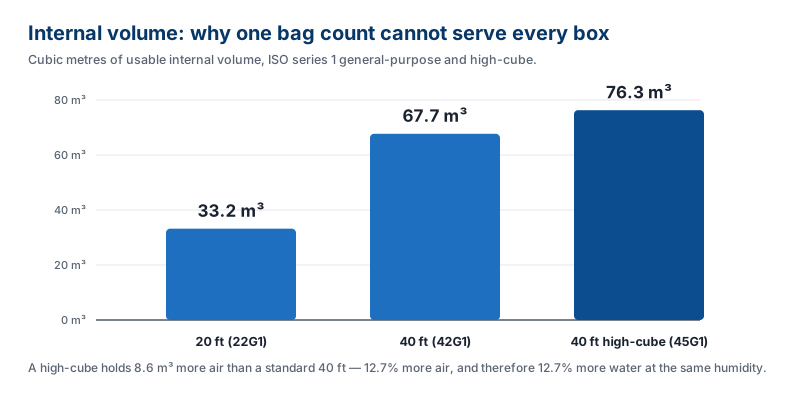
| Container | Internal volume | Loaded at 20 °C, cooled to 10 °C | Loaded at 30 °C, cooled to 10 °C | Loaded at 40 °C, cooled to 10 °C |
|---|---|---|---|---|
| 20 ft (22G1) | 33.2 m³ | 0.15 kg | 0.50 kg | 1.06 kg |
| 40 ft (42G1) | 67.7 m³ | 0.31 kg | 1.02 kg | 2.15 kg |
| 40 ft high-cube (45G1) | 76.3 m³ | 0.35 kg | 1.14 kg | 2.43 kg |
Each column differs from the previous one only in loading temperature; the destination is held at 10 °C and relative humidity at 80% throughout. A reefer held at 0 °C would be a different calculation on a different humidity basis, and it is out of scope for a dry container.
The spread across a single row is the point. The same 40 ft high-cube needs 0.35 kg of absorption if loaded at 20 °C and 2.43 kg if loaded at 40 °C — a factor of seven, from a variable that no supplier asks about. The spread down the table matters too: the high-cube holds 8.6 m³ more than the standard 40 ft, 12.7% more air and therefore 12.7% more water, which is why quoting one bag count for both box types cannot be right.
Convert kilograms to bags using the absorbent's own tested capacity. Silica gel takes up roughly 30–36% of its own weight across 20–60% relative humidity and flattens above 60%. A 500 g silica gel bag therefore holds about 150 g of water at those conditions. Against 1.14 kg of condensate, that is 7.6 bags — call it 8. Against 2.43 kg, it is 17.
Which is where the familiar "twenty bags per 40 ft" comes from, and why it is not a lie so much as an unlabelled number. Twenty bags of 500 g would need to take up about 3 kg of water, which is roughly the 2.43 kg air term above plus the moisture a wet cargo adds over a long voyage. The two figures are only comparable once the bag weight, the loading temperature and the cargo are all stated. Ask for those three before you compare a bag count with a competitor's.
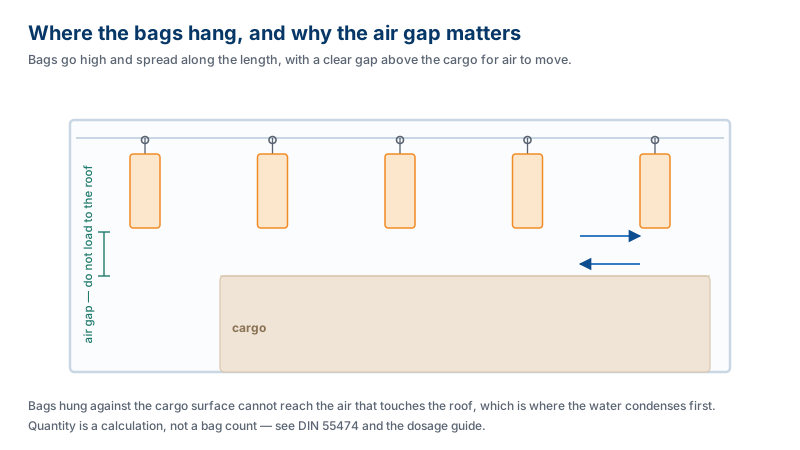
Two caveats, stated plainly. These figures cover condensation only; they exclude moisture carried inside the cargo itself, which for timber, grain or bagged agricultural goods can exceed the condensation load. And they assume the container is sound. Roughly a quarter of wet damage traced by cargo insurers comes from water entering through pre-existing damage to the unit, which no desiccant can fix. Inspect the box before you load it. Loading and securing practice is covered in the UNECE CTU Code, which is where the hanging positions and air-gap requirements for desiccant come from.
Documentation is where a cheap quotation becomes an expensive shipment, and it is the part buyers prepare last.
Four documents travel with every consignment and are non-negotiable: the commercial invoice, the packing list, the bill of lading, and a certificate of origin if you are claiming preferential duty. Three more are product-specific and are the ones suppliers most often forget: a batch certificate of analysis, a technical data sheet, and a safety data sheet.
The certificate of analysis is the one that matters commercially. It should reference the production batch, state the absorbent material, state the measured absorption at named conditions, and be issued against the batch you actually received — not a generic specimen certificate reused across shipments. If your quality system requires traceability, a specimen certificate is worse than none, because it creates a record that does not correspond to the goods.
| Document | Issued by | Why it matters at the border or in an audit |
|---|---|---|
| Commercial invoice and packing list | Supplier | Declared value and quantity must match the entry |
| Bill of lading | Carrier | Title document and delivery instruction |
| Certificate of origin | Chamber of commerce or supplier | Required to claim preferential duty under a trade agreement |
| Batch certificate of analysis | Manufacturer | Proves the batch, not just the product family |
| Technical data sheet | Manufacturer | States capacity at named temperature and humidity |
| Safety data sheet | Manufacturer | Required for handling and for some carriers |
| Import classification | Importer of record, on supplier's advice | Determines duty rate and whether a permit applies |
Classification is the trap. Uncoloured silica gel is classified under 2811.22 in the HS system, and the United States HTS subheading 2811.22.1000 has been confirmed for silica gel in a customs ruling. Coloured or cobalt-indicating product, and preparations that are not simply silica gel, usually fall under 3824.99 or 3824.90 instead. The difference is not academic: it changes the duty rate, and a mis-declared entry can be examined, held and reassessed at destination, with the cost falling on the importer of record. Ask your supplier which code they ship under and why, and confirm it with your broker before the first shipment rather than the fifth.
Incoterms do not change the price of the goods. They change where your cost stops and the seller's begins, and therefore which of the layers above appears on your invoice.
Under FOB, the seller delivers to the named port and clears export; you pay ocean freight, insurance, import duty and inland delivery. Under CIF, the seller also pays freight and minimum insurance to your port, but the risk still passes at the port of loading — a detail buyers discover when cargo is damaged mid-voyage and the claim lands on them. Under DDP, the seller delivers to your door with duty paid, which is the most convenient and the least transparent, because you cannot see the duty and freight components inside the unit price.
| Term | Seller pays | You pay | The detail that catches buyers out |
|---|---|---|---|
| FOB | Export clearance, delivery to port | Ocean freight, insurance, duty, inland | The named port must be written on the quotation |
| CIF | Freight and minimum cover to destination port | Duty, inland, any cover above the minimum | Risk passes at loading, not at arrival |
| DDP | Everything to your door | Nothing visible | Freight and duty are buried in the unit price |
| EXW | Nothing — goods are placed at your disposal at their premises | Everything, including the export declaration | You cannot file the China export declaration yourself, so the seller must still do it, and some will not |
Lead time should never be quoted as a single number. It is four numbers that add up: production days from confirmed artwork and deposit, inspection and packing days, the gap to the next available sailing, and transit time to your port. Ask for each separately. A supplier who can only give a total is either guessing or hiding a slow step, and knowing which step is slow tells you whether to expedite production or change the routing.
A quotation can be cheap and still be the most expensive option on the table. These are the signals worth stopping for.
A bag count with no questions attached. If a supplier tells you twenty bags per 40 ft container without asking the loading temperature, the voyage duration, the cargo type or the box condition, the number was not calculated. It was copied.
An absorption figure with no test conditions. "Absorbs up to 300% of its weight" is a laboratory extreme for calcium chloride, measured under conditions the seller has not stated. Without temperature and relative humidity, the figure cannot be compared to anything, including another supplier's figure for the same material.
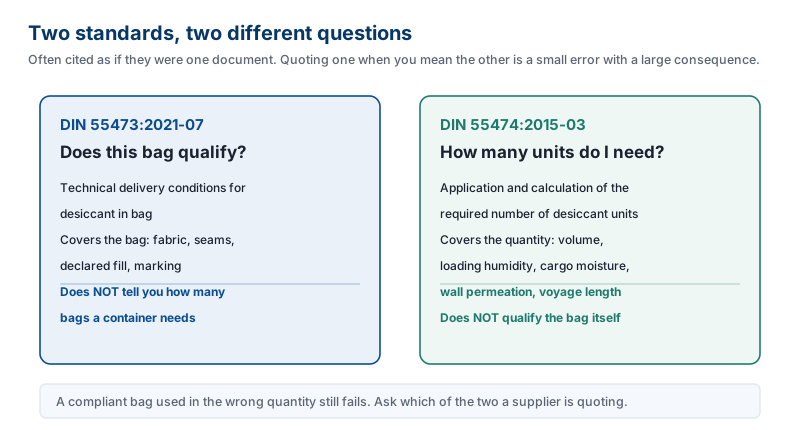
A desiccant unit count with no standard named. A DU is a rating defined by a standard, not a weight, and a supplier quoting one should be able to name the standard behind it. The two that matter are set out below.
A safety data sheet that describes a different product. Copied data sheets are common, and they mean the documentation was assembled by someone who never saw the goods. Check the product name, the material and the revision date against what you ordered.
A price per carton against an MOQ per bag. This is the arithmetic error that costs the most and is the easiest to miss. Get both units on the same line of the quotation, in writing.
A supplier who cannot state the HS code they ship under. Classification sits with the importer of record, so this is your problem to solve rather than theirs to volunteer — but an answer that arrives in one line, with a reason, tells you they ship this product often.
The DIN system separates the two questions cleanly. DIN 55473:2021-07 sets the technical delivery conditions for desiccant bags, which is about whether the bag itself qualifies. DIN 55474:2015-03 covers application and the calculation of the required number of desiccant units, which is about how many you need. A supplier quoting a DU figure should be able to say which of the two it follows, because a bag that satisfies the first can still be used in the wrong quantity under the second.
From a regional distributor, not from a factory. Factories set minimums around production runs, and a production run is not a box of fifty bags. If you need small quantities urgently, the distributor premium is genuinely buying you speed and local invoicing, and it is worth paying. If you need small quantities repeatedly, the cheaper answer is to buy a stock size unprinted in a larger lot and hold it yourself.
It depends on whether the bag is stock or custom printed, and the two numbers are set by different things. Stock sizes are limited by carton and pallet configuration, so they can usually be quoted in relatively small quantities. Custom printed bags are limited by the printing setup, which is a one-off cost that has to be amortised across the run. Always ask for both numbers separately rather than a single MOQ.
Ask for the four components rather than the total: production days, inspection and packing days, wait for the next sailing, and ocean transit. Production and the sailing gap are the two variables a supplier can actually influence, and they are the two that buyers never ask about separately. Transit time itself is a function of routing and season, and any single figure quoted without a routing is an average of things that will not happen to you.
Uncoloured silica gel is classified under 2811.22, and the US HTS subheading 2811.22.1000 has been confirmed for silica gel by customs ruling. Coloured or cobalt-indicating product and other preparations generally fall under 3824.99 or 3824.90. The classification decides the duty rate and whether any import permit applies, so confirm it with your customs broker before the first shipment rather than after an examination.
Calcium chloride holds far more water per gram and keeps working at high humidity, which suits long ocean voyages and wet cargo. Silica gel holds roughly 30–36% of its own weight across 20–60% relative humidity and then flattens, which suits general cargo and controlled conditions. Bentonite clay takes 20–28% and is fastest below 20% relative humidity but loses performance above 40%. The choice changes the bag count, so settle the material before you compare quotations, or you will be comparing two different products at two different dosages.
Buy from a factory when you can forecast, from a distributor when you cannot, and from a marketplace only when you have already decided the specification and just need a box. Compute your own dosage from loading temperature and box volume instead of accepting a bag count. Ask for the batch certificate, the standard reference and the HS code before you compare prices, because those three decide whether the cheap quotation is cheap. Then check the numbers against our desiccant quotation checklist and run your own figures through the container desiccant calculator before you place the order.
If you are still deciding which suppliers are worth quoting at all, the companion guide on how to tell a real desiccant factory from a trading company covers the qualification side. For dosage worked through in more detail, see desiccant dosage per container; for the material comparison in depth, see calcium chloride container desiccant. Bulk and wholesale enquiries are handled on our products page.
Send the bag format, quantity and destination port — you get a firm figure, not a range.