We use cookies to measure traffic and to show relevant advertising. Nothing is stored or sent until you choose, and you can change your choice at any time.
Most of the companies you find under this search term do not make desiccant. They buy finished bags, sometimes re-label them, and sell them with a manufacturing story attached. That is not automatically a problem — a well-run trader with tight incoming inspection can serve you perfectly well. The problem is that you cannot tell the two apart from a website, and the cost of guessing wrong arrives months later as a rejected container.
The risk is not marginal. TT Club, the transport mutual insurer, reports that around 65% of cargo damage incidents are attributable in part to the way goods are packed inside the cargo transport unit. Desiccant is part of how goods are packed. When it underperforms, you do not get a warranty claim — you get wet cartons, rusted components, and a customer who does not order again.
This guide gives you eight written questions, four production steps, and a certification matrix that will separate a real desiccant factory from a repacker in about one working day, without a factory visit.
The word is used for at least four different business models, and they have very different capabilities. A true manufacturer owns the compounding step — the part where calcium chloride, silica gel or clay is processed into an adsorbent with a controlled uptake curve. A converter owns the bag-making and filling lines but buys compound from someone else. A repacker buys finished, sealed bags in bulk and prints its own cartons. A trader owns no plant at all and buys from any of the above.
The distinction matters because only the first two can change a specification. If your cargo needs a specific uptake at 30 °C, or a bag that will not dust onto precision parts, a repacker cannot engineer that — it can only offer what is already in the warehouse.
| Supplier type | What they actually own | What they can change for you | Usual giveaway in conversation |
|---|---|---|---|
| Manufacturer | Compounding, converting, filling, QC lab | Adsorbent formulation, uptake curve, bag construction | Talks about batch records and lab conditions before price |
| Converter / filler | Bag-making and filling lines; buys compound | Bag size, fabric, print, seal type — not the adsorbent | Can quote bag specs instantly but defers on adsorption data |
| Repacker | Warehouse and a printing line | Carton artwork, pack count, label language | Asks which brand you currently buy, then quotes that SKU |
| Trader | Nothing but relationships | Price and payment terms only | Every technical question is answered with "I will check with the factory" |
Read that last column carefully. It is the fastest filter available to you, and it costs one email.
Ask for a video walk-through rather than photographs — photographs can be licensed, borrowed or taken at someone else's plant, and a two-minute unedited phone video that pans across a working line cannot. Four steps should appear in sequence, and each one proves something specific.
Step one, compounding or blending. The adsorbent is processed to a target specification. This step proves the supplier can control uptake, not just resell it. A trader has nothing to show here.
Step two, bag converting. Non-woven fabric is formed, cut and sealed into bags. This step proves the supplier controls dust release — the single most common cause of complaints when desiccant sits next to machined parts or electronics.
Step three, filling and sealing. Powder goes into the bag and the seam is closed. This step proves the seal is a production process with a tolerance, not a hand operation.
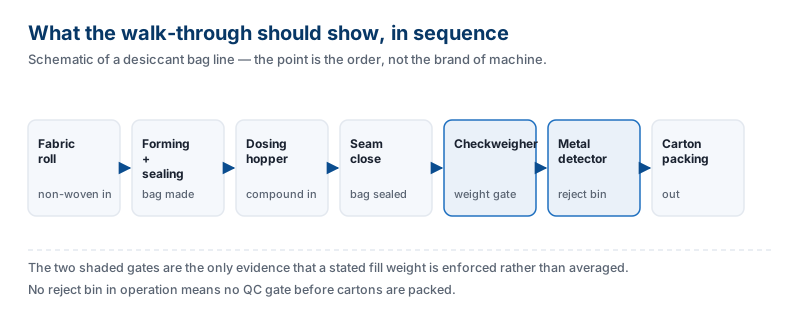
Step four, checkweighing and metal detection. Every bag is weighed and passed through a detector. This step proves the supplier has a reject mechanism, which is the only evidence that a stated fill weight is enforced rather than averaged.
| Step | What to ask to see | What it proves | What its absence suggests |
|---|---|---|---|
| Compounding / blending | Mixer or granulator running, with a batch record | Control over the adsorbent itself | Supplier buys finished compound |
| Bag converting | Fabric roll feeding a forming and sealing machine | Control over dust release and seam strength | Supplier buys finished bags |
| Filling and sealing | Powder dosing into bags, seam closing | Fill weight is a process, not an estimate | Manual or outsourced packing |
| Checkweigh and metal detection | Reject bin in operation, plus a test-piece log | Stated weight is enforced; contamination is screened | No QC gate before carton packing |
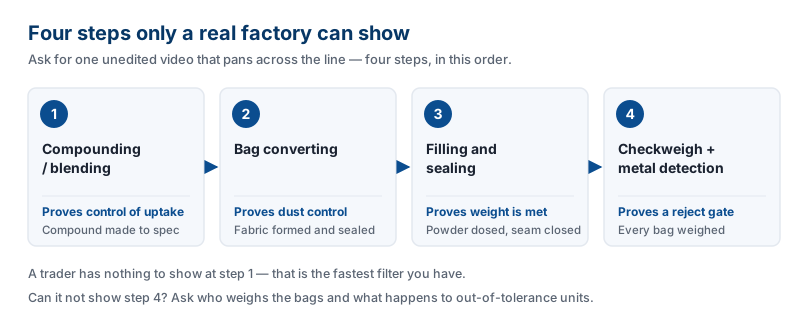
A factory that cannot show step four is not automatically disqualified, but you should then ask who weighs the bags and what happens to out-of-tolerance units. Vague answers here are the most reliable predictor of short-weight shipments.
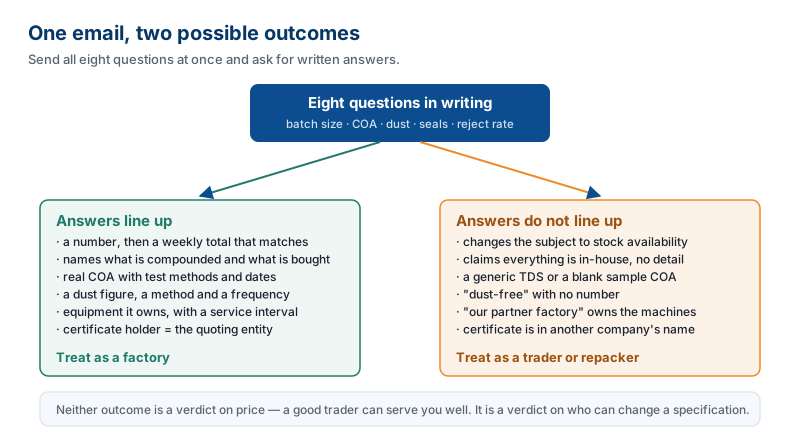
Send them in writing, all eight at once, and ask for answers in writing. Spoken answers are rehearsed; written answers have to be consistent. What you are reading for is not the content of each answer but the pattern across all eight.
| # | Question to send | A factory tends to answer | A trader tends to answer |
|---|---|---|---|
| 1 | What is the batch size of one production run, and how many runs per week? | Gives a number, then a weekly total that matches | Changes the subject to stock availability |
| 2 | Which adsorbent do you compound in-house, and which do you buy? | Separates the two honestly, names what is bought | Claims everything is in-house, no detail |
| 3 | Can you send the batch COA for the material you would ship us? | Sends a real COA with test methods and dates | Sends a generic TDS or a blank sample COA |
| 4 | What is the measured dust release, and how do you test it? | Names a method, a limit and a test frequency | Says "dust-free" without a number |
| 5 | Who owns the bag-sealing machines, and how often are they serviced? | Names its own equipment and a service interval | Says "our partner factory" |
| 6 | What is your reject rate on fill weight, and what happens to rejected bags? | Has a rate and a disposal route | Has never been asked, improvises |
| 7 | Which certificates are held by your legal entity, not by a group company? | Matches certificate holder to the contracting entity | Certificate is in another company's name |
| 8 | If we audit, whose gate do we walk through? | Gives an address that matches the quote | Gives a trading office address, then hesitates |
Question seven is the one most buyers skip, and it is the one that matters most at customs and in a claim. A certificate held by a group affiliate is not worthless, but it does not transfer to your contract automatically — ask for the certificate holder's exact legal name and compare it to the name on your proforma invoice. If they differ, ask why in writing.
Certificates are usually listed as a row of abbreviations — ISO 9001, ISO 14001, ISO 45001, REACH, RoHS, DIN 55473 — as if they were interchangeable badges. They are not. Each one answers a different question, and several of the questions buyers assume are covered are not covered by any of them.
| Certificate or document | The question it actually answers | What it does not tell you |
|---|---|---|
| ISO 9001 | The supplier has a documented quality system and is audited against it | Whether the product performs to any particular specification |
| ISO 14001 | There is a managed environmental process | Anything about product quality |
| ISO 45001 | There is a managed occupational health and safety process | Anything about product quality |
| REACH | The substances involved are registered and not restricted for the declared use | That the adsorbent meets a stated uptake |
| RoHS | Restricted substances are within limits for electrical applications | Suitability for food, pharma or precision metal |
| DIN 55473:2021-07 | The bag meets the German technical delivery conditions for desiccant in bag | How many bags your container needs |
| DIN 55474:2015-03 | How the required number of desiccant units is calculated and applied | Whether the specific bag you receive qualifies |
| Batch COA | What this specific lot measured, with methods and dates | Consistency across lots, unless you trend several |
The two DIN standards are the pair most often cited as if they were one document. They are not, and the titles make the split clear. DIN 55473:2021-07 covers *auxiliary means of packaging — desiccant in bag — technical delivery conditions*, which is about whether the bag itself qualifies. DIN 55474:2015-03 covers *desiccants in bag — application, calculation of the required number of desiccant units*, which is about how many you need. Quoting one when you mean the other is a small error with a large consequence: you can hold a perfectly compliant bag and still use the wrong quantity.
What none of these documents prove is the thing you most want to know — that the adsorbent will still be working when the container is opened eleven weeks later. Only a batch COA trended across several shipments, plus a retained sample you can test yourself, gets close to that. Ask for the last four COAs, not the last one.
This is the decision that sets your unit cost and your failure mode, and it is usually made by whoever answers the email fastest rather than by whoever has the data. All three materials work; they work in different humidity bands and they fail differently.
Silica gel is the default for container work. It holds roughly 30% to 36% of its own weight across the 20% to 60% relative humidity band, and it plateaus above about 60% RH — it does not keep absorbing indefinitely. Its failure mode is quiet: it simply stops, and the remaining moisture stays in the air.
Calcium chloride is the high-humidity choice and the one most often misquoted. Figures as high as 300% of its own weight circulate widely; those are laboratory extreme values measured under specific temperature and humidity conditions, not a working figure for a container. Calcium chloride also deliquesces — it turns to liquid as it loads — so the bag construction, not the chemistry, becomes the limiting factor.
Bentonite clay is the low-cost option and the fastest of the three below about 20% RH. Above roughly 40% RH its performance degrades, which makes it a poor fit for tropical sailings loaded in humid weather.
| Material | Typical uptake, as % of own weight | Effective humidity band | Failure mode | Ask the supplier for |
|---|---|---|---|---|
| Silica gel | ~30–36% | 20–60% RH, plateaus above 60% | Stops absorbing; no visible sign | Uptake curve with test conditions |
| Calcium chloride | Up to ~300% in laboratory extremes; not a working value | Strongest at high RH | Deliquesces; leakage risk at the seam | Deliquescence behaviour and bag construction |
| Bentonite clay | ~20–28% | Fastest below 20% RH; degrades above 40% | Loses capacity in humid loading conditions | Uptake at your actual loading humidity |
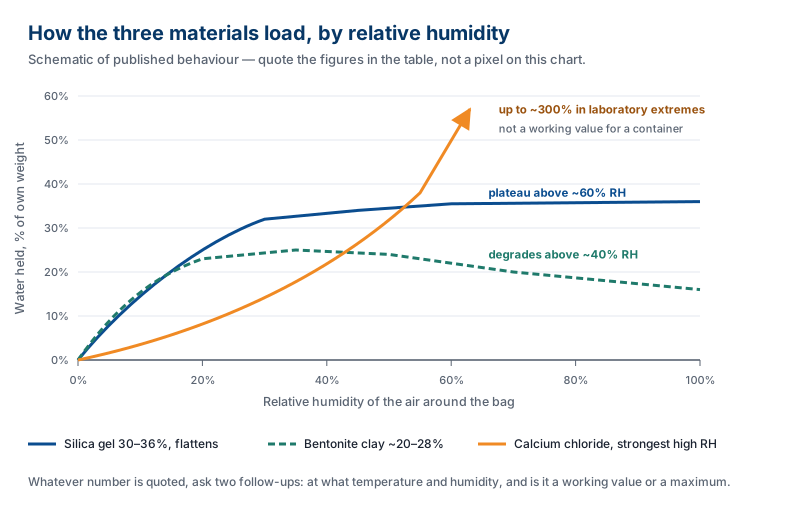
Whatever number a supplier quotes, ask two follow-ups: at what temperature and humidity was it measured, and is it a working value or a maximum. A supplier who answers both without hesitation is telling you something useful about how it sells. For a deeper comparison of how material choice interacts with transit mode, see our material deep-dive on calcium chloride container desiccant and the ocean versus air freight comparison.
The formats we supply for container use are listed on our products page, with sachet weights from 0.5 g to 1 kg and custom specifications on request.
Because the quantity of water that has to be removed depends on the temperature at which the container was loaded, and almost nobody accounts for it. Practical rules of thumb — a fixed bag count per container size — treat the box as a constant and the weather as irrelevant. The physics does the opposite.
The stakes are not marginal. Cargo insurers report that around 65% of cargo damage incidents are attributable in part to the way goods are packed within the cargo transport unit, and the UNECE CTU Code treats moisture control as part of packing practice rather than an accessory to it. A fixed bag count is a packing practice, and it is the one part of the practice nobody recalculates.
Water vapour is invisible and its mass per cubic metre rises steeply with temperature. The saturation vapour density of air is roughly 0.005 kg/m³ at 0 °C, 0.009 at 10 °C, 0.017 at 20 °C, 0.030 at 30 °C and 0.051 at 40 °C. Take a 40ft high-cube container, 76.3 m³ of internal volume, loaded at 80% relative humidity and then cooled to 10 °C on passage. The air can hold only so much, and the excess has to go somewhere — onto the roof, then onto your cargo.
| Loading temperature (80% RH) | Water carried by the air | Air capacity at 10 °C | Water that must condense |
|---|---|---|---|
| 20 °C | 1.04 kg | 0.69 kg | 0.35 kg |
| 30 °C | 1.83 kg | 0.69 kg | 1.14 kg |
| 40 °C | 3.11 kg | 0.69 kg | 2.42 kg |
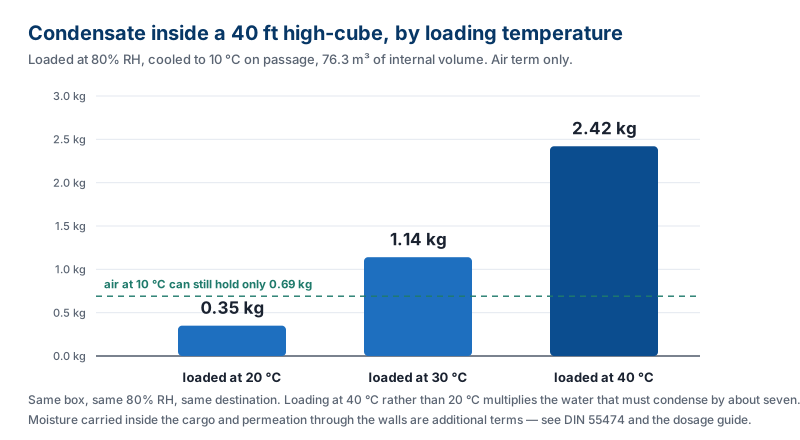
Same box, same humidity, same destination. Loading at 40 °C instead of 20 °C triples the water in the air and roughly sevenfolds the amount that has to condense. A fixed "20 bags per 40ft" figure is calibrated to one of these rows and wrong for the other two.
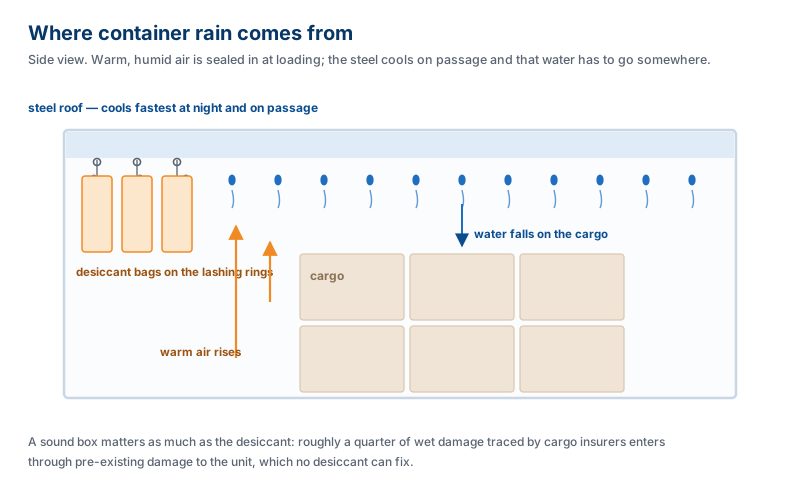
This is the air term alone. DIN 55474 adds the moisture carried in by hygroscopic packaging and cargo, and the water vapour that permeates the container walls over the voyage duration — which is why voyage length, not just box size, belongs in the calculation. Our dosage guide walks through the additional terms, and the container desiccant calculator applies them to your actual route and loading temperature.
Not quality, in the abstract — capability and commercial structure. The three origins have different strengths, and the right answer depends on what you are buying and how much risk you can absorb.
China dominates on volume and on flexibility of bag construction. The practical difference is that you can get a custom bag size, a custom print and a mixed-material formulation at volumes that European plants will not quote, and you can usually see the line. The trade-off is that the spread between the best and worst factories is wide, which is exactly why the eight questions above matter. Certification held by the contracting entity rather than a group affiliate is the point to check hardest.
Europe offers short lead times, DIN-standard documentation as a default, and a lower audit burden — often no audit needed at all because the supplier's quality system is already accepted by your customer. You pay for that in unit price and in minimum order quantities that can be an order of magnitude above Chinese plants.
India sits between the two on cost and is strong on silica gel for industrial packaging, with growing capacity for container formats. Documentation practice varies more between suppliers than within Europe, so the COA request in question three does more work here.
| Origin | Strongest at | Weakest at | Check hardest |
|---|---|---|---|
| China | Custom bag construction, volume flexibility, mixed formulations | Wide spread between best and worst plants | Certificate holder vs contracting entity |
| Europe | Documentation, short lead time, low audit burden | Unit price, minimum order quantity | Whether MOQ applies to your actual bag size |
| India | Cost on silica gel, growing container capacity | Documentation consistency between suppliers | Batch COA with methods and dates |
None of this is a ranking. A buyer with a customer audit to pass and a four-week window should probably be in Europe. A buyer specifying a non-standard bag for a twelve-week route should probably be in China, and should spend the saved money on inspecting the batch.
Send this as a single document, with your route, cargo and loading conditions already filled in. A supplier who answers all twelve in writing has either done this before or has a technical person on staff — both are good signs. One who answers six and attaches a catalogue has told you what you needed to know.
Item seven is the one that produces the most revealing answers. A supplier that returns a number without working has copied it from a table. A supplier that returns the calculation — volume, loading humidity, voyage duration, uptake per unit — has someone who understands what the product does. For a fuller list of the commercial documents that should accompany the goods, see our quotation checklist, and for what each certificate means in practice, our certifications page.
Once two or three factories have answered, the next decision is commercial rather than technical — which route actually delivers the bag at the lowest landed cost. Our companion guide on container desiccant suppliers covers the cost layers, the MOQ structure, the documents that must ship, and how to compute the bag count yourself.
Ask for an unedited video walk-through covering compounding, bag converting, filling and checkweighing, then send the eight written questions and compare the pattern of answers. Request the last four batch COAs with test methods and dates. If all three line up, you have reasonable confidence without travel; if any one of them is evasive, the visit becomes worth the cost.
No, and assuming so is a common mistake. A trader buying in volume can undercut a small factory on a standard bag, and can ship from stock in days rather than weeks. The trader becomes expensive when you need something the warehouse does not hold — a non-standard uptake, a specific fabric, a bag format for your container. At that point you are paying for a specification change nobody can make.
DIN 55473:2021-07 sets technical delivery conditions for desiccant in bag — whether the bag qualifies. DIN 55474:2015-03 covers application and the calculation of the required number of desiccant units — how many you need. One is a product qualification standard, the other a calculation standard, and a compliant bag used in the wrong quantity still fails.
There is no single number, which is why any supplier quoting a flat figure should be asked to show the working. The requirement depends on internal volume, the absolute humidity at loading, the moisture carried by cargo and packaging, the permeation rate of the container walls, and the voyage duration. A 40ft high-cube loaded at 30 °C and cooled to 10 °C must shed about 1.14 kg of water from the air alone; loaded at 40 °C the figure is about 2.42 kg.
Usually, but not for the reason buyers assume. The saving on a bag is small against the value of the cargo it protects, so the arithmetic only turns against you when the bag underperforms — short fill weight, dust contamination, or a seam that fails under load. The expensive outcome is not the price difference; it is a rejected container at destination.
The lot or batch number, the test methods used, the measured values for uptake and dust release, the date of manufacture and the date of testing, and the name of the entity that issued it. A COA without methods is a certificate of intention, not of measurement. Ask for four consecutive lots so you can see whether the values drift.
Send your specification and route — we will answer the eight questions in writing, with batch COAs.